Question

CONTEST: What’s Your #MyGongSecret with AI Agents?

  • March 2, 2026
  • 18 replies
  • 606 views

Nisha Baxi


You’re a Gong power user — and you deserve a reward for your expertise. 

So I want to hear how you are using Gong AI Agents to drive real results inside your organization.

Share your best practice in the Visioneer Community between now and March 20, 2026 at 12:00 PM CST for a chance to win 30 minutes with Gong CEO, Amit Bendov.

In your 1:1 you can:

  • Ask for business advice
  • Workshop your sales pitch
  • Or even learn Amit’s favorite songs to play on guitar 

And that’s not all…

The first 10 people who submit a best practice will receive Gong swag.

One standout submission, selected by Gong, will win a 30-minute meeting with Amit.  

Here’s how to participate:

1. Share your story
In the comment box below ⬇️ , submit a high-quality write-up (screenshots encouraged) or a short video showing how you’ve used Gong AI Agents to streamline processes and drive better results. Be sure to include which AI Agent in the header you’re using and the step-by-step process you followed to achieve your outcome! 

Here are a few helpful links to set you up for success:

2. Bonus points if you amplify your submission on LinkedIn (tag me so I know you posted: https://www.linkedin.com/in/nishabaxi/):

  1. Include a link to this thread so others can explore all the best practices being shared
  2. Use the hashtags #ImAGongVisioneer #GongCommunity #MyGongSecret
    You might even get a like from Gong! 😉

3. Watch for the winner
We’ll announce the winner on March 24th and celebrate them across our channels.

See Terms and Conditions. 


Good luck and DM me with any questions!


Nisha Baxi
Head of Community @ Gong
18 replies

Nisha Baxi
  • Author
  • Community Manager
  • March 9, 2026

Here is the full list of Gong AI Agents:
https://help.gong.io/docs/understanding-ai-agents 


Nisha Baxi
  • Author
  • Community Manager
  • March 9, 2026

 ​@Gijs Bos! ​@Travis Chichester, ​@tooliodan, ​@John Machak, ​@Matt Gardner​​​@Leigh Oxley, ​@Rae Guimond, ​@Shahina, ​@Alexandra, ​@TLee McNabb, ​@Beatrice Dobre, ​@Rebecca, ​@Michelle Sanchez, ​@Bangi, ​@Kerry Heilskov, ​@Jason Dailey, ​@Chris Reiling, ​@jbrown2024, ​@Lenny Goh, and ​@Oliver Wood  


Nisha Baxi
  • Author
  • Community Manager
  • March 9, 2026

@Justin Benton@Ian Gwynne, @Isabella Grandchamp @John Machak @Delila House @Viktorija @David Roi @Kayla Kuzer @Jacob Walker @SaaS Revenue Guy @Alex Heller @Ezz24  @Susan Kilcline @Jeff Smith @Matt Gardner @Christina Mowry @Laura Bailey and @Annie Jackson 


  • Community Newbie
  • March 9, 2026

We’ve had a few great use cases for AI tools in Gong! Recently, we switched to Gong Engage and have really leaned into the platform.

Before using Gong Engage, our SDR team handled manual handoffs to our AE team. That process often meant spending 5–10 minutes cleaning up notes and formatting them into something digestible. Now, our SDRs use the AI Briefer in Gong to quickly surface the key information our AEs need, saving 5+ minutes on every meeting that gets set.

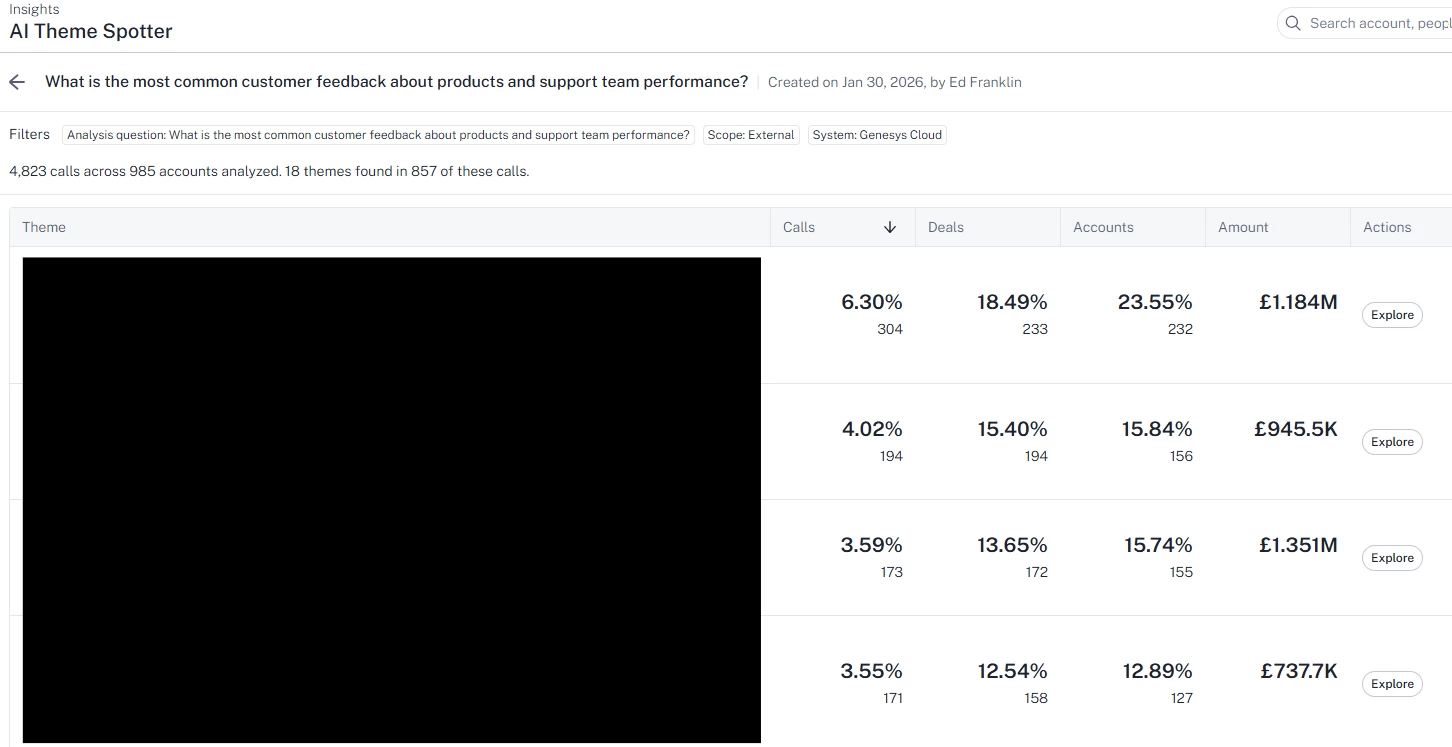
We also launched a new product and wanted to quickly understand the objections we were hearing so we could get immediate feedback to our product team. We initially started by sorting through Conversations and using the “Ask AI” feature, but decided to go deeper.

We created a custom Smart Tracker for objections specific to our business, then used the AI Theme Spotter to identify patterns across calls related to the new product launch. This gave us actionable insights for both our product and marketing teams. It also helped our expansion sales team refine their narratives and proactively address objections before they surfaced in conversations.


AI Tracker - Higher value sales


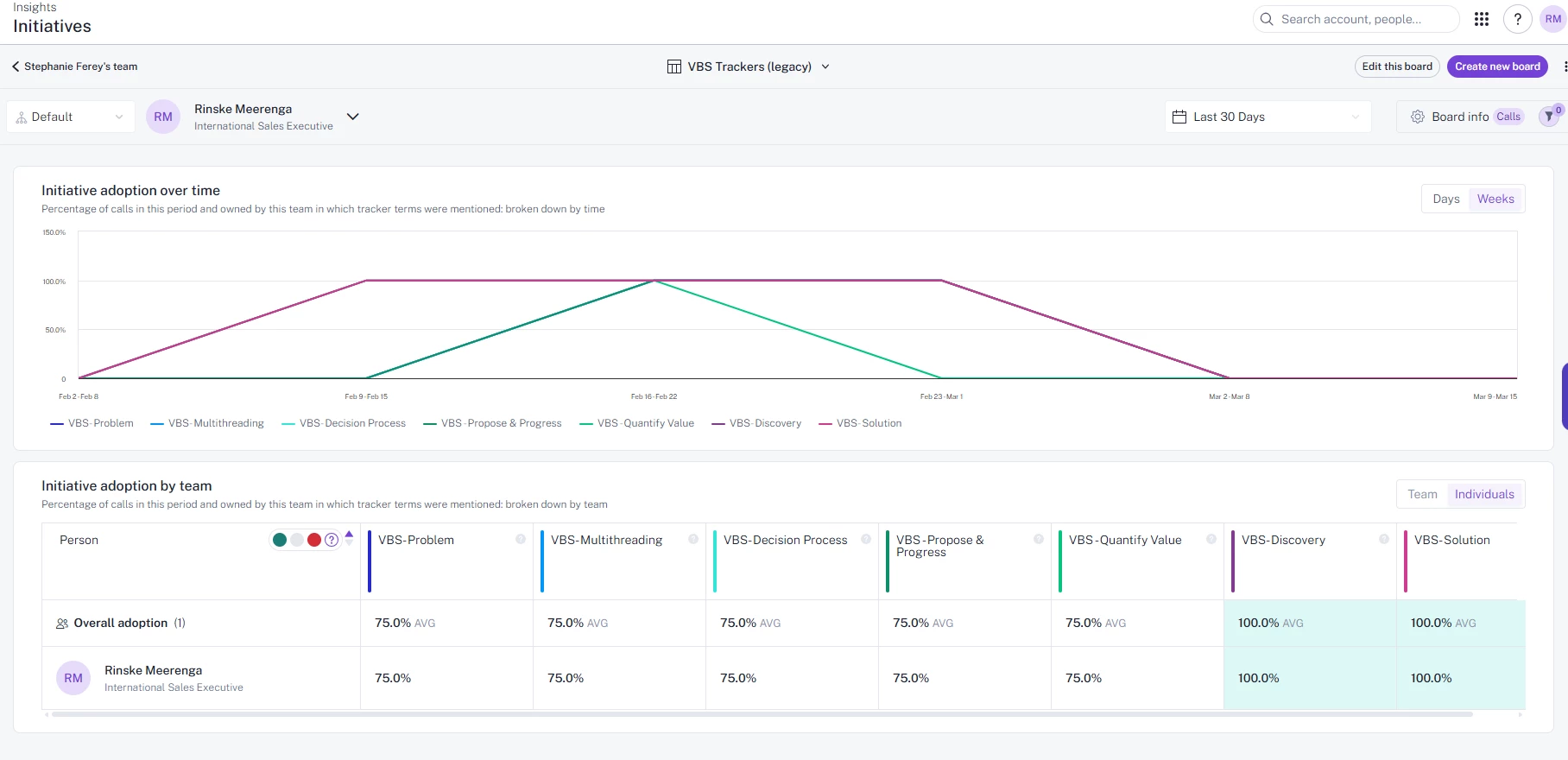
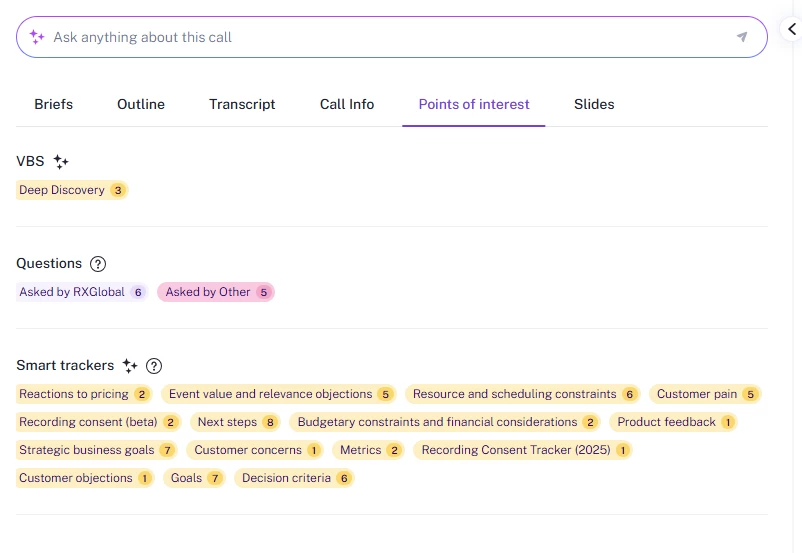
I use the AI Tracker to ensure my sales approach stays focused on value. At RX, we aim to sell through Value-Based Selling (VBS), and the AI tracker helps me stay aligned with that goal and provided me a way to review this.

After each call, I review the points of interest and the Smart Trackers, specifically looking for those connected to VBS. This helps me identify what resonated with the client and what I may have missed, so I know exactly what to build on in our next conversation.

Points of Interest trackers

II also review the Insights Initiatives page to see which elements I have or haven’t been including in my conversations over the past month. This helps define my focus for the month ahead. 

Initiatives tracker

I’ve noticed that deals where these trackers appear often result in a better, more personalized fit for the client, and frequently lead to higher revenue as well. That’s because VBS conversations naturally open the door to more Value Added Services (VAS) that support the client’s objectives.

Overall, the AI Tracker helps me reflect on my VBS habits and identify where to adjust my focus for upcoming conversations and future opportunities.


At Posh, we use Gong on the CS team to track the valuable strategies that we mention to our stakeholders. I used AI Briefer to pull out these strategies, categorize them into themes, and outline CS next steps. It’s been super helpful for our CS team to extract these from their calls and keep this info logged. 


aframpton
  • Community Newbie
  • March 9, 2026

@Nisha Baxi This if my FAVORITE topic of conversation 🙌🏻

--------------------------------------------------------------

AI Agent: AI Builder – Win/Loss Pattern Analysis (2025)


The Use Case:

As our team looked deeper into 2025 performance, we realized our CRM win/loss fields weren’t reliable enough to identify real patterns on why we win and why we lose. We wanted to understand what themes influenced wins vs. losses directly from buyer conversations.

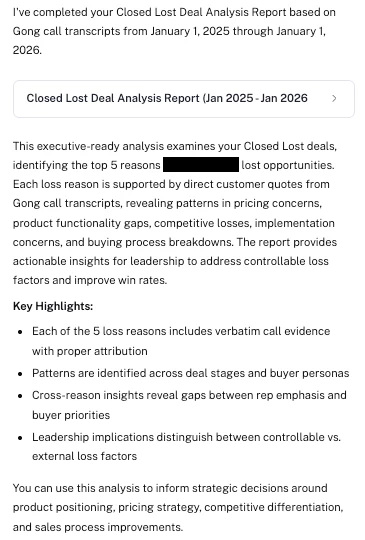
To solve this, we used the Gong AI Builder to analyze closed won and closed lost deals and extract patterns directly from calls and emails.

The Process:

1. Define the dataset
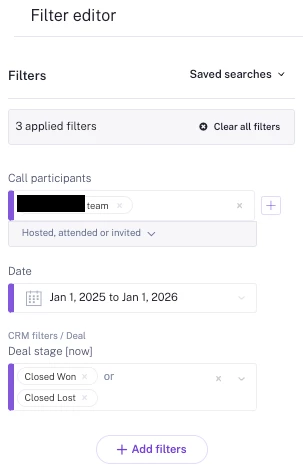
We filtered Gong deals for new logo (i.e. our Sales Manager’s Team) Closed Won and Closed Lost opportunities (respectively) from 2025 to ensure the analysis was focused on relevant buyer conversations & behavior.

2. Build a custom AI prompt in Gong AI Builder
We created a prompt asking the AI to analyze all conversations associated with these deals and identify:

  • Common themes influencing wins / losses

  • Signals tied to buying momentum (budget, urgency, champion engagement, etc.), following our SPICED methodology 

  • AE related actions that may have influenced the deal one way or another, even if not directly documented 

We specifically instructed the AI not to summarize each deal individually, but instead to focus on aggregate patterns across all deals. We also asked Gong to include quotes from calls/emails and examples that illustrate each identified pattern to make sure the analysis was grounded in real buyer language. 

3. Review the aggregated insights
The AI output gave us a structured summary of:

  • Top source identifiers mentioned by buyers

  • Recurring reasons for wins & recurring drivers behind losses (respectively) 

  • Emerging signals related to budget, timing, and expansion potential

The Outcome:

This workflow allowed us to cross check incomplete CRM data with real buyer conversations and quickly identify patterns we would have otherwise missed. We mapped these against reported win/loss reasons and started using these insights to:

  • Strengthen discovery and qualification frameworks

  • Provide real examples of buyer language for sales training

  • Inform marketing & demand generation strategy to pad ToF with ICP-specific prospects 

Instead of manually reviewing dozens of deals, Builder allowed us surface these patterns in minutes.
--------------------------------------------------------------

What’s Next?

We’ll start doing this analysis at the end of each quarter, and split per product line to help us identify trends for specific products and at different time points in the year. Instead of using this as a lagging indicator (e.g. all of 2026 data), we’ll use it real-time to make changes in our enablement & training strategies for our team.

Excited to see how other teams are using this!


Forum|alt.badge.img
  • Community Newbie
  • March 9, 2026

Moving Beyond the Numbers: How We Use Gong Theme Spotter to Drive Executive Insights
 

As part of the GTM Strategy, Planning & Operations team at Cisco ThousandEyes, our period-end reporting is a critical touchpoint. However, our executives consistently challenge us to go beyond the raw data: they want the "why" behind the business outcomes.

To bridge this gap, we’ve integrated Gong Theme Spotter into our workflow to uncover the narrative behind the metrics.

Our Process:

  1. Identify Key Themes: Using Gong Theme Spotter, I isolate top competitor insights, customer value realization patterns, and product feedback trends.
  2. Contextual Synthesis: I extract these insights and feed them into a project within our internal AI tool, which is pre-loaded with historical reporting packages.
  3. Narrative Generation: The AI synthesizes the Gong data with our historical context to draft a narrative that explains the business performance, rather than just reporting it.

The Result:

By leveraging this workflow, we are shifting from manual data aggregation to strategic storytelling. This approach has allowed us to:

  • Increase Insight Depth: We now provide actionable context that helps leadership make informed decisions.
  • Save Time: Automating the synthesis of reporting packages significantly reduces our manual preparation time.

I’m excited to see how this evolves as we continue to refine our AI-driven reporting!


Forum|alt.badge.img+6
  • Community Newbie
  • March 9, 2026

We’ve been so impressed with Gong’s active expansion of their AI suite, and have seen such a huge impact here at Avalara through the use of several of these great tools!

Our biggest focuses in 2025 & 2026 have been around creating a more unified approach to outbounding across our hundreds of sellers and various sales teams/segments. Some ways in which Gong has helped include:

  • AI Tasker: Many of our Engage users are customer-facing, working with current/active customers. It’s increasingly important that we stay in front of these customers and reply to them in a timely manner. Paired with Gong’s responsiveness metrics, AI Tasker serves as a virtual assistant to make sure we’re always responding to customers when necessary, pushing deals forward, and not allowing anything to fall through the cracks
  • AI Briefer: We were particularly excited for the launch of this one. Before, the handoff process of accounts from team to team or rep to rep was extremely manual and clunky. We love the ability to build custom brief formats in order to hit all of the most pertinent information when passings accounts from SDRs to SEs to CAMs. It’s saved us a ton of time in conversations and manual handoff buildout. Also looking forward to diving into Data Extractor soon here to start pushing Gong data into SFDC fields for the same purpose
  • Ask Anything & Trackers: These have been paramount in helping us determine how we’re meeting our customers/prospects in our external-facing conversations, and where we’re leaving things out on the table. With trackers, we can easily see what percentage of conversations mention given products or add-ons. And with the addition of Ask Anything across all calls, we can now have Gong help us more easily determine commonalities on calls like how those products were talked about. These insights are invaluable for coaching & development conversations with our reps. Plus, paired with AI Builder, we get actionable content to turn around & use from the call insights we’re able to grab

Forum|alt.badge.img
  • Community Newbie
  • March 10, 2026


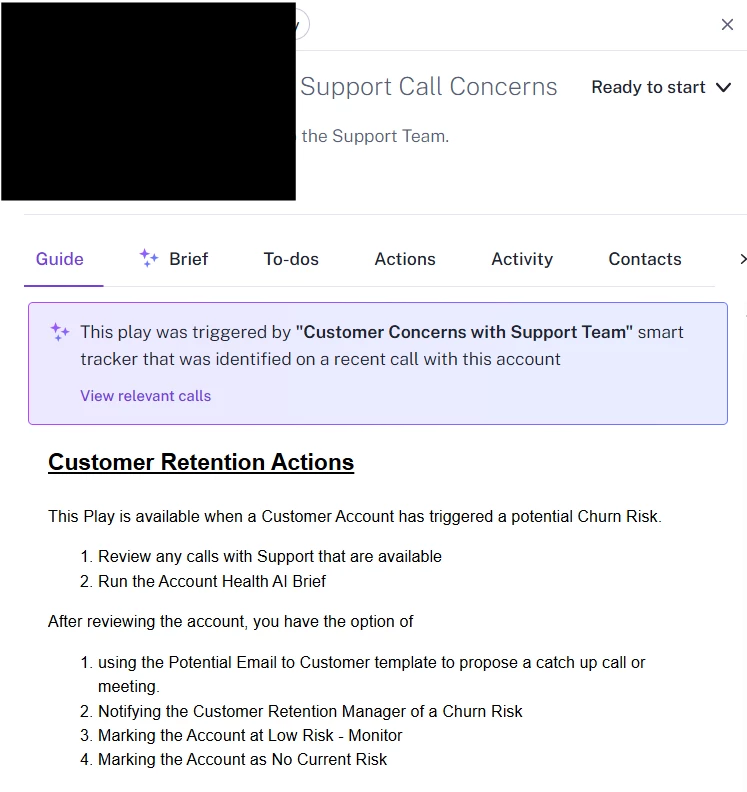
We’re fortunate to be testing an early release of Orchestrate. 

This year we started including calls to our Support Team and set up AI Trackers for any churn risk indicators such as:

  • Expressions of frustration or dissatisfaction
  • Repeated or unresolved support issues
  • Escalation language or mentions of cancellation
  • Adoption challenges, pricing concerns, or workarounds

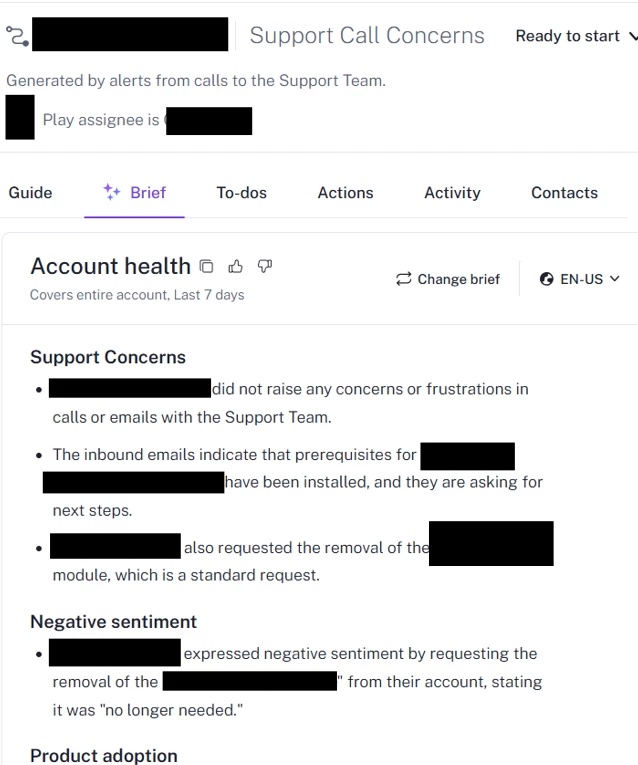
We then added an Automation for each tracker alert that creates a To-Do for the Customer’s Account Manager, including an AI Briefer for Churn Risk looking at all calls and emails.


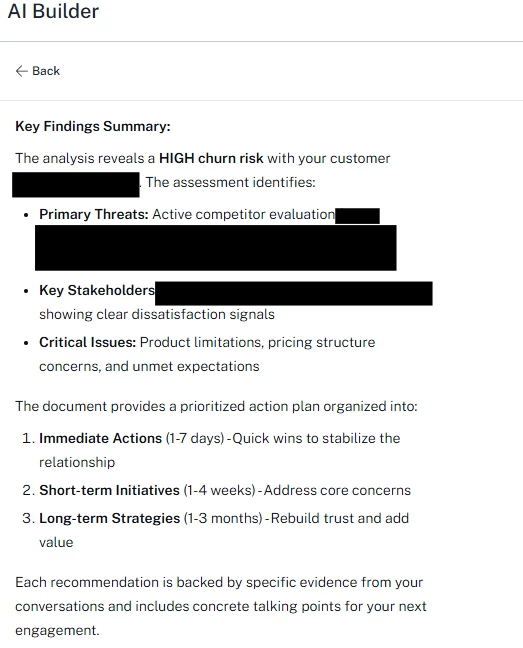
In addition, we’ve used the AI Builder to run a weekly review of all Customers, highlighting Churn Risk and grading it High, Medium and Low. For the High Risk accounts we then get the AI Builder to write a mini-Churn Prevention Action Plan, based on previously successful retention strategies. That is shared with their Account Manager, Customer Success Manager and the Customer Retention Manager.


Finally, we use AI Themes to look at all customer interactions in the month and identify themes across Product, Support, Customer Success, and Sales that are contributing to Churn Risks. This is shared with senior management as well as key stakeholders.


  • Community Newbie
  • March 10, 2026

From 28,000 Unanalyzed Calls to an Enablement Engine: What AI Builder Made Possible in My First 90 Days

When I joined Canopy Tax as Head of Enablement, I walked into something a lot of enablement folks will recognize. A company that had been doing the right things in theory, but hadn't fully unlocked what was sitting right in front of them.

Canopy had Gong. Had it for years. Thousands of calls recorded, reps talking to customers every day, a goldmine of real conversation data. But the AI features? Largely untouched. No scorecards being run at scale. No AI-driven analysis. Just a library.

A library with 28,000 calls in it.

I was brought in to build an enablement org from essentially nothing, and I was handed three major deliverables in my first 90 days.

Build an onboarding program from scratch. No existing framework. No documented process. Just a blank page and a lot of institutional knowledge living in people's heads, and apparently, in 28,000 Gong calls.

Identify GTM skill gaps and build a training for our company Kick-off. I needed to diagnose what was actually happening across our Outbound, Account Management, Customer Success, Implementation, Migration, Support, Professional Services, and Sales Engineering teams and do it fast, without months of ride-alongs and shadowing.

Build a comprehensive Pricing & Packaging training. We were moving to new offerings, and I needed to use our Beta team's actual calls to show the GTM org how to position and sell the new packages. Not hypotheticals, but real examples from real conversations.

Here's where AI Builder changed everything.

I am not exaggerating when I say I became obsessed with this tool. The idea that I could take that inherited library of 28,000 calls and actually ask it questions, surface patterns, identify coaching moments, pull examples, analyze how messaging was landing, was a complete unlock for someone building an enablement org from the ground up.

Instead of manually scrubbing through calls trying to find where reps were struggling with objection handling, I could identify it systematically. Instead of guessing at what good looked like for our new pricing conversations, I could pull the Beta team's best calls and build the training around real evidence.

For the Kick-off training, AI Builder helped me move from gut instinct to data-backed gap analysis. I could walk into that room and say: here's what we're seeing across the org, here's where we need to focus, and here's proof. That's a different conversation than "here's what I think based on a few weeks of observation."

For Pricing & Packaging, it let me curate real examples of what great looks like. Reps navigating the new offering confidently, handling tough questions, building value. The Beta team's calls became a training library I could actually use.

I'm still early in this journey and I know we're scratching the surface of what's possible. But if you're sitting on a Gong instance that hasn't had AI turned on, or you've been meaning to explore AI Builder and haven't gotten there yet, just start. Especially if you're in an enablement role where you're trying to build fast and prove impact quickly.

The calls are already recorded. The data is already there. AI Builder just finally let me put it to work.


Daniel Brown
  • Community Newbie
  • March 11, 2026

AI Agent: AI Tracker

How a DPT Used Gong AI Tracker to Transform Territory Conversations in the Field

I'm Daniel Brown, Area Sales Manager for the Rocky Mountain Region at Bioness — and I'm also a Doctor of Physical Therapy with 12 years of clinical experience. I sell neurorehabilitation technology to the same clinicians I used to work alongside. That context matters for this story.

When I joined Bioness, I noticed my calls weren't generating the depth of conversation I wanted. Customers were giving short answers. Momentum was slow. I knew the clinical world I was selling into — but I wasn't unlocking it in my sales conversations.

What I did with AI Tracker:

I used Gong's AI Tracker to analyze our team's calls and extract the discovery questions that were generating the highest customer engagement — measured by response length, conversational depth, and forward momentum. The output was a ranked framework of questions organized by category: clinical application, decision-making process, budget and timing, space and logistics, and outcomes measurement.

The shift:

I took that framework into the field this week routing my Denver territory. Instead of leading with product, I led with questions like:

  • "What does your current patient population look like?"
  • "What are you using to drive the motor component when you're doing mirror therapy?"
  • "What would success look like for your therapy program?"

Here's what Gong couldn't have anticipated: because I'm a PT asking these questions, my accounts knew I understood the answers. The conversations shifted immediately. Clinicians stopped talking to a sales rep and started talking with a colleague. They went deep — sharing frustrations, expansion plans, budget cycles, and clinical gaps they'd never surface in a typical vendor call.

The result:

My Denver route this week produced the most meaningful account conversations I've had since starting this role. Not longer calls — better ones. Stronger relationships, higher trust, and a clear list of next steps from every interaction. The pipeline intelligence I brought back was richer than anything I'd captured before.

The takeaway:

AI Tracker didn't replace my clinical instincts — it systematized them. It showed me, with data, what great clinical conversations look like. Then I took those questions into the field and let my PT background do the rest. That combination — AI pattern recognition plus human clinical credibility — is something I don't think many reps can replicate.

That's my Gong secret.

#ImAGongVisioneer #GongCommunity #MyGongSecret


Attached is the document that gong helped me create: 


Forum|alt.badge.img+2

🚀 Using AI to Build a Better Call Library (and Save Hours of Review Time!)

During our SKOs earlier this year, one common request from the team was a refreshed library of great customer calls. We technically had one—but most of the calls were outdated or no longer aligned with our current strategies.

I was tasked to rebuild this library from scratch.
At first, I tried creating a stream to capture all calls tied to closed deals… but after reviewing a few, I realized the manual process would take forever.

That’s when I turned to AI Call Reviewer and AI Builder.

✨ I drafted a new scorecard and used AI Builder to refine and finalize it.
✨ I plugged it into AI Call Reviewer—and the impact was immediate.
👉 My review time dropped from ~30 minutes per call to just ~10 minutes.

Because of that efficiency, I finished the new call library much earlier than expected. And now, we’re already exploring how to extend this workflow to other teams like Pre‑Sales and Customer Success.

AI isn’t just “nice to have”—it’s quickly becoming essential in how we scale knowledge, quality, and productivity across teams. Excited for what we build next. 💡


AI Agent: Gong AI Call Summaries & Recommended Actions

One of the most impactful ways I’ve used Gong AI Agents is to eliminate manual note-taking and turn customer conversations directly into actionable insights.

My Workflow

  1. Customer Call Happens: Gong automatically records and analyzes the conversation across meetings, emails, and interactions—creating a single source of truth for the engagement.
  2. AI Generates Instant Call Summary: Within minutes, Gong produces a structured summary highlighting key discussion points, risks, and next steps. No more scrambling to write post-call notes.
  3. Share Real Customer Evidence: Instead of sending written summaries, I share specific call snippets or the AI-generated summary with stakeholders. This helps align teams quickly on what the customer actually said.
  4. Act on AI-Recommended Follow-Ups: Gong suggests follow-up actions and emails, making it easy to move the deal forward immediately.

The Impact

  1. ~30–40% less time spent on post-call admin
  2. More accurate CRM capture of customer interactions
  3. Faster deal reviews using real conversation insights instead of second-hand notes

Bottom line: Gong AI Agents turn customer conversations into insights, actions, and better commercial outcomes.


Forum|alt.badge.img+6
  • Community Newbie
  • March 16, 2026

AI Tracker + AI Briefer + AI Call Reviewer + AI Deal Reviewer
How I Built a Discovery Excellence Engine in Gong

At Wolters Kluwer Legal & Regulatory U.S., we did what most sales organizations do: rolled out a discovery methodology at our January 2026 Sales Conference, watched reps leave energized, and then watched the behaviors quietly fade. No visibility into what was actually happening in the field. No way to know which discovery elements were missing. No data to connect discovery quality to pipeline outcomes.

I used 4 Gong AI agents together to build a living, self-reinforcing Discovery Excellence program. Running these three agents together turned discovery from a one-time training initiative into an ongoing performance system. Managers have a coaching structure they actually use. Reps get consistent, behavior-specific feedback. And I have the data to connect discovery quality to pipeline outcomes

Step 1: AI Tracker, Define What "Good Discovery" Actually Sounds Like

Before you can reinforce a behavior, you have to be able to see it.

I built a suite of AI Trackers mapped directly to our discovery framework, each one tuned to detect whether reps were hitting the behaviors that matter: asking about business impact, uncovering decision criteria, surfacing urgency, identifying competitive presence, and confirming next steps before ending a call.

The key was training the trackers on language variations, not just exact phrases. Reps don't all ask about urgency the same way, and the tracker needed to reflect that reality. Once live, I back-dated them against 90 days of prior calls so we immediately had a baseline.

What this gave us: a signal layer across every discovery call, without a manager having to listen to a single recording to get it.

Step 2: AI Briefer, Turn Call Intelligence Into Coaching Currency

I deployed three brief types as part of the program, each serving a distinct purpose in the discovery workflow, The workflow I trained reps on:

  • Pre-call: Open Account Brief + Contact Brief → Ask Anything about open discovery gaps → scan Deal Board Playbook
  • Post-call (within 2 hours): Review Call Brief → check Scorecard → validate AI-suggested notes to CRM → note which trackers did and didn't fire

Step 3: AI Call Reviewer, Close the Feedback Loop at Scale

The AI Call Reviewer Scorecard automatically scores every call marked in the Discovery stage against five behavioral criteria tied directly to our framework: 

  • For reps: Every discovery call gets assessed. They see their own scores. They can click any low-scoring criterion and it jumps directly to that moment in the call.
  • For managers: The 1:1 workflow changed completely. Before the session, they review the last two discovery calls and identify the lowest-scoring criterion. In the 1:1, they click the score, play the 30-60 second clip together, and ask the rep to walk through their thinking. One behavioral improvement. One focus. Tracked over time.The shift in language this creates is significant. It moves managers from "I feel like that call was a little weak" to "We scored 2/5 on Business Impact. Let's listen to minute four together." That specificity changes the entire coaching conversation.
  • For enablement: I can look across the full team and spot patterns.

Step 4: Deal Reviewer Playbook + Salesforce CRM

The AI agents above create visibility. The Deal Reviewer Playbook creates accountability. We also built a Discovery Excellence section directly into every Salesforce opportunity four required fields corresponding to the four pillars, pre-populated by Gong AI and validated by reps. This means the discovery work done in Gong becomes the source of truth in CRM, not a separate manual entry task.

The Results

Lastly, AI Builder helped me with an analysis that examines sales calls from Q1 2026 to identify discovery excellence in practice across Wolters Kluwer's sales organization. The findings reveal consistent patterns of effective discovery techniques including deep needs analysis, multi-threading, business impact questioning, and consultative problem-solving. Top-performing reps demonstrate excellence by asking open-ended questions, actively listening, understanding the broader business context, and positioning solutions based on discovered needs rather than leading with product features.

Discovery is measurable in a way it never was before. Managers have a clear pipeline inspection gate. Reps have a self-coaching loop after every call. And I can connect discovery execution to pipeline quality using actual call evidence which is the conversation sales leadership actually wants to have.


Forum|alt.badge.img

AI Call Reviewer | How we built a 3-tier coaching model to drive more consistent Customer Success engagements

We use Gong’s AI Call Reviewer as the foundation of our Customer Success QA program to create more consistent customer engagements, deliver more actionable feedback, and scale coaching across every level of the organization.

Before this program, coaching was more manual and less consistent. Managers had to review calls one by one, feedback quality varied, and it was difficult to roll insights up from the frontline to leadership in a way that actually changed behavior.

With AI Call Reviewer, we built a three-tiered coaching approach that helps us turn call reviews into action at the executive, manager, and individual contributor levels.

Our process

1. Standardize how quality is measured
We use AI Call Reviewer to evaluate calls against the behaviors and conversation patterns that matter most to our Customer Success organization. This gives us a more consistent way to assess engagement quality across teams, instead of relying only on subjective call reviews.

2. Surface trends at the executive level
For our C-Suite and senior leaders, we roll call review outputs up into aggregated org-level insights. This helps leadership quickly spot broader patterns across the business, such as strengths, risk areas, and where coaching or enablement investments are most needed.

3. Give managers team-level visibility
For managers and frontline leaders, we use the output to identify team-level themes. That helps them focus their 1:1s, team coaching, and enablement sessions on the areas that will have the biggest impact, rather than guessing where to spend time.

4. Deliver real-time, actionable feedback to individual contributors
For CSMs and frontline team members, AI Call Reviewer creates faster, more specific feedback on their customer conversations. Instead of waiting for periodic manual QA, they get guidance tied directly to the engagement itself, which makes coaching more immediate and easier to apply in the next customer interaction.

5. Reinforce consistency at scale
Because the same framework is used across the org, we can coach more consistently, identify patterns faster, and create a tighter feedback loop between what’s happening in customer conversations and how we improve performance.

Business impact

This approach has helped us:

  • Drive more consistent customer engagements across the team

  • Give leaders clearer visibility into where coaching is needed most

  • Make manager 1:1s and team enablement more targeted and effective

  • Provide frontline team members with timely, actionable feedback they can apply immediately

  • Scale QA and coaching in a way that is much more efficient than fully manual review

The biggest win has been turning QA from a retrospective exercise into a practical coaching system. Instead of just reviewing calls, we now use Gong to connect executive visibility, manager coaching, and frontline execution in one continuous loop.

For anyone trying to scale quality in Customer Success, this has been one of the most effective ways for us to combine AI-driven insights with human coaching.


AI Briefer & AI Builder: Transforming Account Transitions & QBRs for AE’s & Leaders (to ultimately yield a stronger customer experience and win rate)

At our organization, we didn't just adopt Gong's AI tools — we built workflows around them that fundamentally changed how our account teams prepare, hand off, and grow accounts. Here's what we built and why it worked.

Agent 1: AI Briefer for Account Transitions

Account transitions are one of the highest-risk moments in any customer relationship. The customer shouldn't have to repeat discovery. The incoming AE shouldn't walk in blind. We used Gong's AI Briefer to solve both problems.

We built two custom briefs — one for the outgoing rep, one for the incoming rep — each with approximately 10 structured sections covering relationship history, open opportunities, key stakeholders, past objections, and strategic context. The result: AEs entered their first customer conversations already prepared, and customers experienced continuity rather than a reset. We also layered in Gong's Prepare for Meeting tool so that when a transition call was already on the calendar, the incoming rep could walk in with a real-time briefing on top of the handoff brief. The combination meaningfully reduced ramp time and protected customer trust during a period in Q1 when we had a high volume of transitions in play.
 

Agent 2: AI Builder + Briefer for Quarterly Business Reviews

QBRs are where strategy lives or dies. We used Gong's AI Briefer and AI Builder in tandem to build a QBR operating system for our reps and leaders.

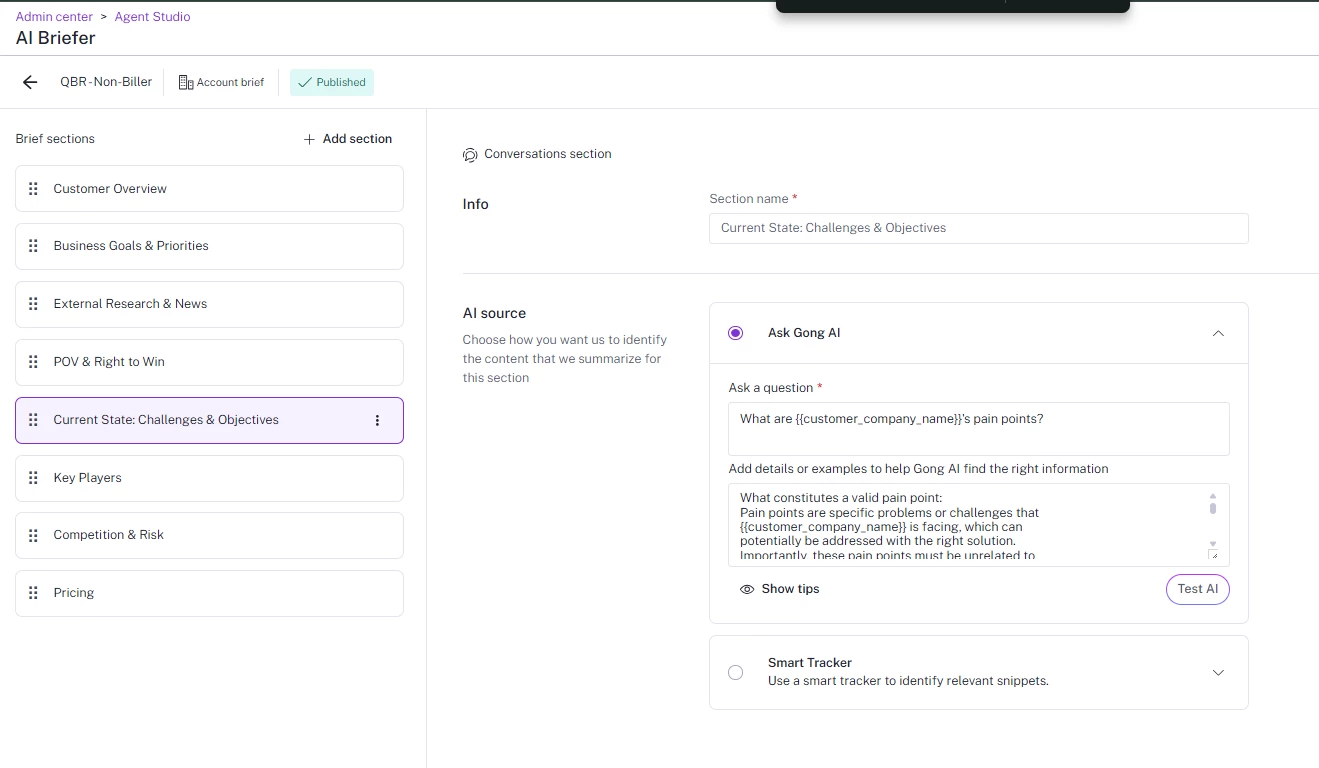
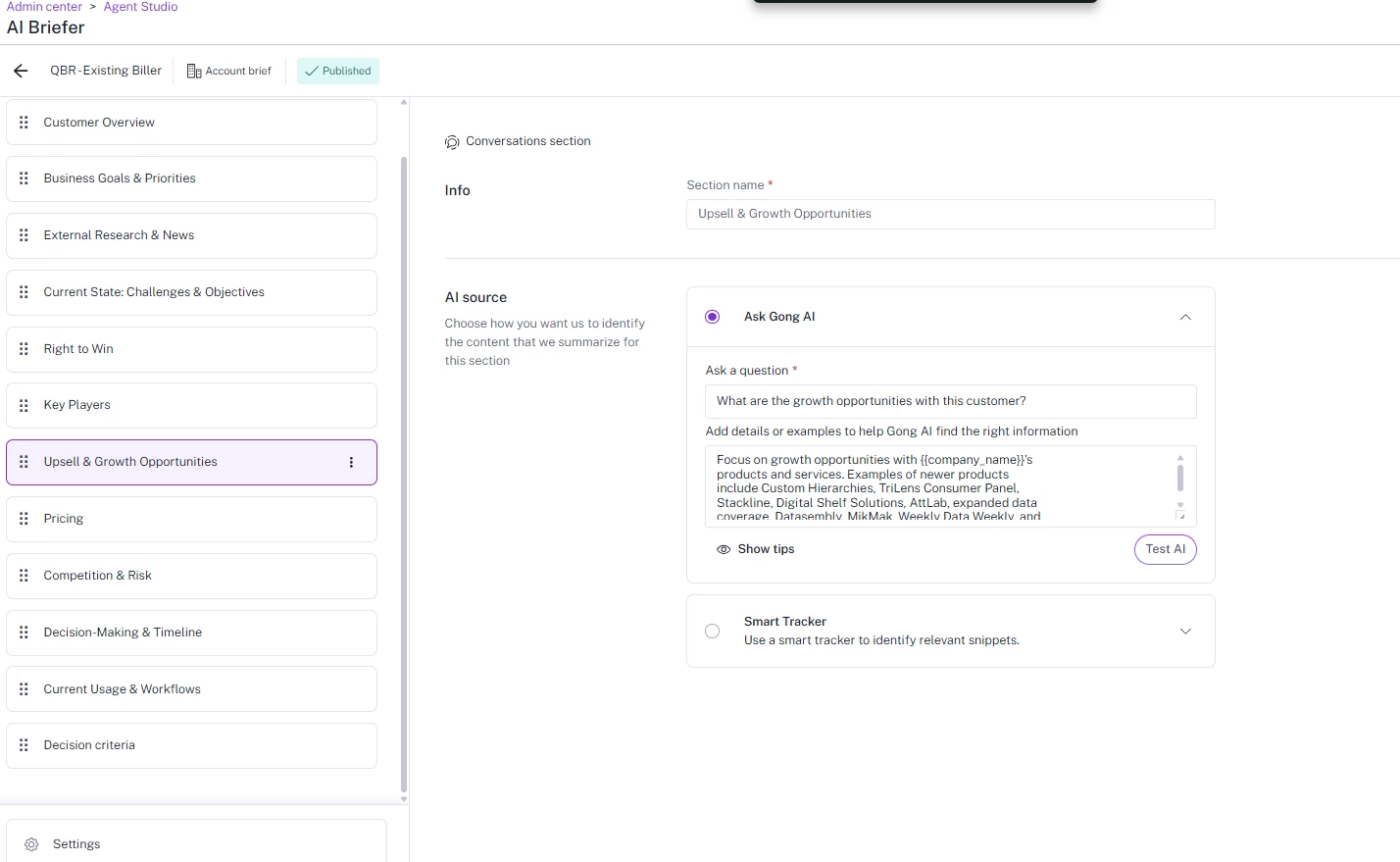
On the rep side, we created two custom AI Briefers: QBR Biller for existing clients and QBR Non-Biller for prospects. Each delivered a structured account strategy overview — what's working, what's at risk, and what moves to make — ahead of the quarterly review.

Reps were required to run at least five briefings going into their QBRs, which meant they showed up with a point of view rather than a recap. Reps remarked that this legitimately “saved them days” in prepping for their QBRs.  They then synthesized the account briefs into a shortened PPT and used during their QBRs with their Leaders. 

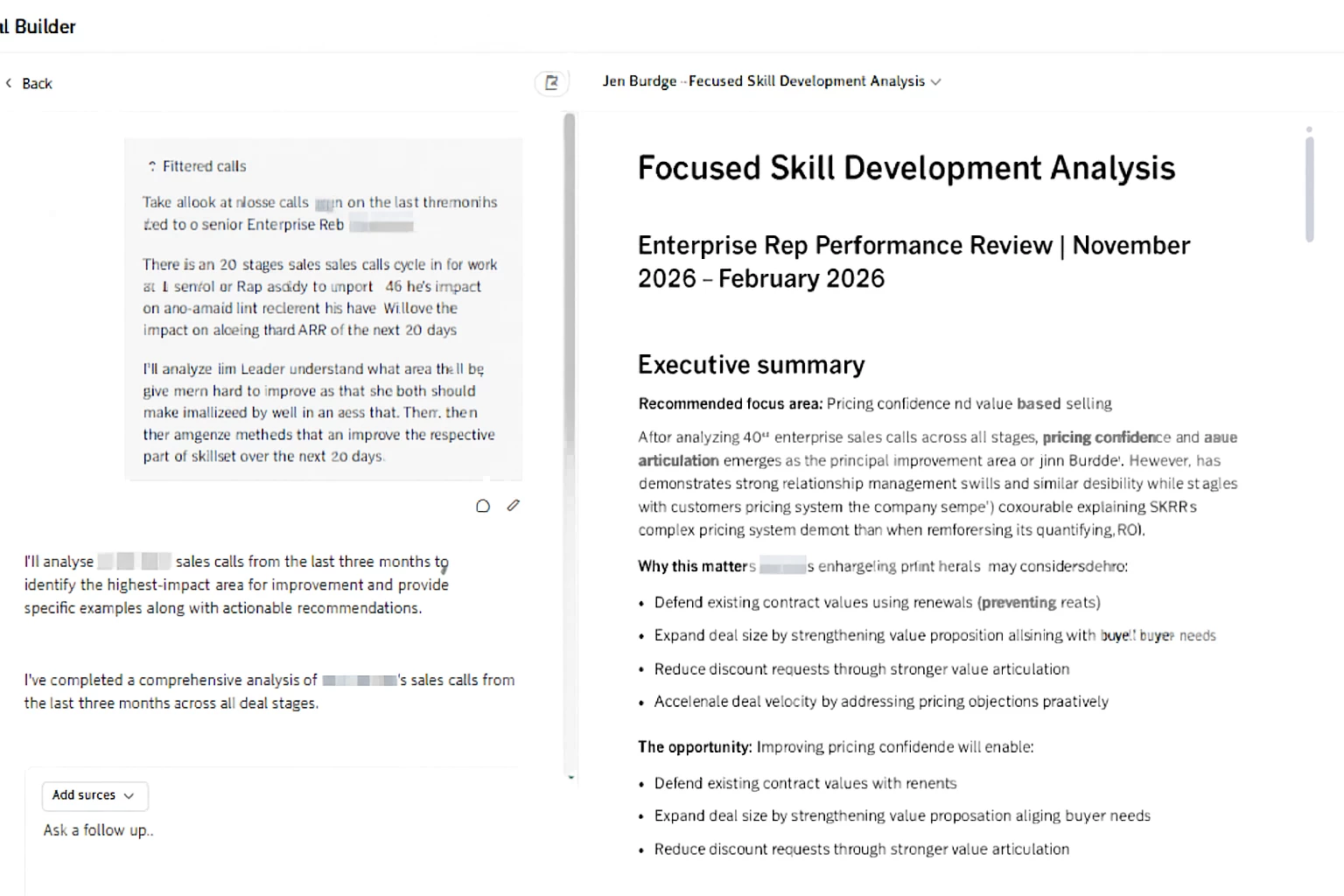
On the leader side, we used Gong's AI Builder to create a structured 90-day call review framework. Leaders ran this before 1-on-1s and QBRs to surface where each rep was excelling and where they needed coaching. It turned the QBR from a reporting exercise into a live, data-backed coaching conversation — grounded in actual call behavior, not anecdote.
 

The Outcome

Gong's AI Briefer and AI Builder didn't just save time — they raised the floor on preparation across the entire team. In Q1, a quarter with significant transition activity and strategic pressure, our reps were better prepared, our leaders were better equipped to coach, and our customers experienced less friction. That's the kind of compounding ROI that makes AI adoption worth the investment.


Nisha Baxi
  • Author
  • Community Manager
  • March 24, 2026

@Sydney Tress Congratulations on being selected as the winner of this contest!! The selection committee felt that your entry was the most comprehensive sharing your end to end experience, systematic and touched multiple agents!  Way to go! I’ll send you a separate note with next steps on your 1:1 with Amit! 


Thank you so much for your entries and the hard work that you’ve put into writing and sharing your stories. I was so impressed! ​@Blake Buckley ​@Rinske Meerenga ​@Chelsea Alterman ​@aframpton ​@Sierra.Evans ​@Maddy Sirois ​@Ed Franklin ​@Jake Joosten ​@Daniel Brown ​@jamesmakiramdam ​@Ayrielle Berryman ​@Sydney Tress ​@Sam Morris Samsara ​@Jake Bernstein


For everyone that submitted entires up until today, I will be sending you something as a thank you and lookout for ways to share your stories on social media and in other places so stay tuned! If you have other feedback on ideas on events, programs or anything I can do to make the community better, please let me know. I am also looking for someone to run an Admin meetup so let me know if you’re interested.